Royal dog breeds and the stories behind royal dogs
Elizabeth II's corgis, Charles II's spaniels, and Queen Victoria's Pekingese Looty put familiar dogs at the center of royal history. Other breeds served as palace sentinels or found favor with aristocratic households. Follow the pets, portraits, and court traditions behind their royal reputations.
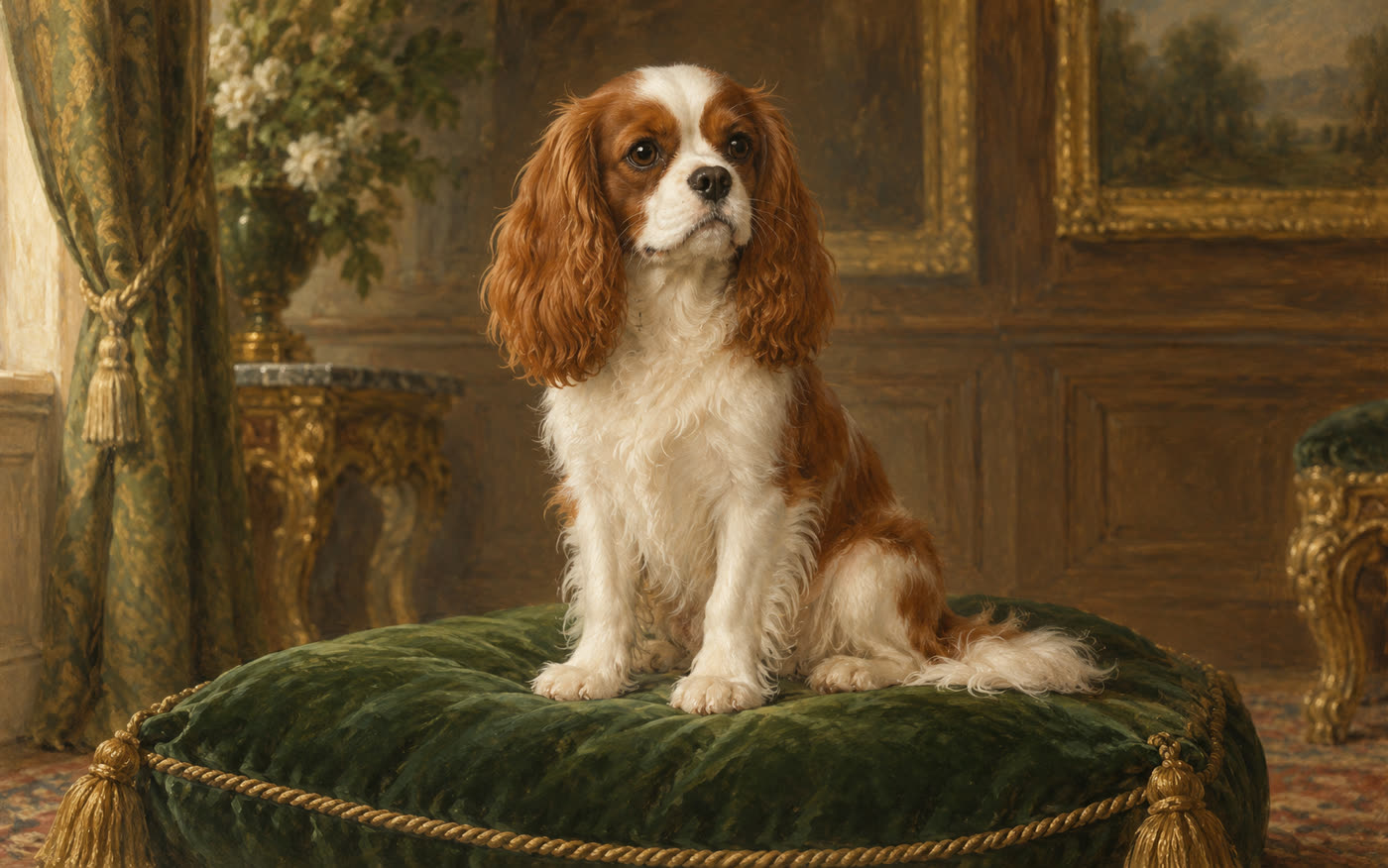
AI-generated illustration, not a historical image.
For the feline side of palace life, meet royal cats. Our guide to historic cat breeds follows cats through letters, exhibitions, and preservation efforts.
Pembroke Welsh Corgi
The future King George VI, then Duke of York, brought home Dookie in 1933. Elizabeth received Susan on her eighteenth birthday in 1944: a birthday puppy at the start of an association that would become inseparable from the public image of the queen and her dogs.
Elizabeth II owned more than thirty corgis from 1952 until her death in 2022. When Willow died in 2018 she briefly had no full-bred corgis, but in 2021 she was given two more, Muick and Sandy. After her death in 2022, Prince Andrew and Sarah, Duchess of York, adopted the two surviving corgis. Her final years therefore differed from the familiar picture of a household with full-bred corgis. Dookie, Susan, and Willow give that long history a personal thread: dogs remembered by their names, much as any owner remembers the companions who shared a lifetime.
Cavalier King Charles Spaniel
Toy spaniels were kept at European courts from the Renaissance. Charles I and Charles II favored them, and the Cavalier's name honors Charles II. After the Stuarts, the older spaniel type nearly disappeared.
In 1926, American Roswell Eldridge offered prize money to recreate that old-type spaniel. The effort led to the Cavalier; a breed club followed in 1928, and The Kennel Club recognized it in 1945.
Pekingese
According to the American Kennel Club, or AKC, Pekingese records date to the Tang dynasty in the eighth century, when the breed was kept by the imperial family.
Captain John Hart Dunne took a Pekingese during the looting of the Old Summer Palace in 1860 — the source of the name Looty. His letter dates the event to October 6, 1860, during the Second Opium War. He presented the dog to Queen Victoria, who named it Looty. Friedrich Wilhelm Keyl painted Looty in 1861. The portrait is in the Royal Collection.
Shih Tzu
Shih Tzu were kept at the Chinese imperial court during the Ming and Qing dynasties. Breed accounts commonly credit Empress Dowager Cixi with a palace breeding program, and court eunuchs are said to have bred the dogs too; where the breed first came from — Tibet or China — is still debated.
Lady Brownrigg brought a pair to England in 1928. The Kennel Club recognized the breed in 1940, and the AKC registered it in 1969.
Lhasa Apso
Lhasa Apsos served as sentinel dogs in Tibetan palaces and monasteries and have long been associated with the Dalai Lama. In 1933, the thirteenth Dalai Lama reportedly gave a pair to C. Suydam Cutting. The AKC recognized the breed in 1935.
Japanese Chin
According to the AKC, the Japanese Chin was bred as a companion for nobility and royalty, although an origin in China or Korea remains debated. The breed's name changed from Japanese Spaniel in 1977.
Pug
Queen Victoria bred her own pugs, including Olga, Pedro, and Minka.
Legend says that in 1572 a pug named Pompey saved the Prince of Orange, leading to the breed's association with the House of Orange. Josephine is also said to have used her pug Fortune to carry messages while imprisoned at Les Carmes.
Great Pyrenees
The Great Pyrenees was adopted at the French court in the seventeenth century. Breed histories say Madame de Maintenon and the Dauphin brought the dogs to Louis XIV's court, and that Louis XIV declared the breed the Royal Dog of France.
Saluki
According to the AKC, the Saluki was regarded as a royal dog of Egypt and was sometimes mummified like pharaohs. The AKC dates relevant tomb images to about 2100 BC and says experts suggest the breed may be far older. Salukis arrived in England in 1840.
Italian Greyhound
The AKC lists royal admirers of the Italian Greyhound including Anne of Denmark, Mary Beatrice d'Este, Frederick the Great, Catherine the Great, and Queen Victoria. The breed's first AKC registration was in 1886.
Bichon Frise
According to the AKC, the Bichon Frise found favor under Francis I and had its greatest success at the court of Henri III. The association also notes the breed's appearance in paintings by Goya.
Papillon
According to the AKC, the Papillon was a favorite of European royal courts, and Marie Antoinette was an ardent admirer.
Borzoi
Borzoi were bred by Russian aristocracy in the seventeenth century. They were called Russian Wolfhounds until 1936.
Myths and misconceptions
Charles II's dogs had a legal right to go anywhere
There is no support for the special-law story or the claim that Charles II neglected state business for his dogs. He did favor toy spaniels.
Modern Cavaliers descend directly from Charles II's dogs
The modern Cavalier developed through Eldridge's effort to revive an older spaniel type. Direct descent from the king's own pets has not been established, and a royal name does not prove a modern dog's ancestry.
The Great Pyrenees received its title in a precisely documented year
Breed histories place the French court connection in the seventeenth century but do not establish the exact year of the declaration.
Pekingese saved an emperor
The story that Pekingese saved an emperor is unsupported. The breed's imperial ownership and Looty's journey to Victoria's household are separate parts of its history.
FAQ
What makes a dog breed “royal”?
The description usually refers to a breed kept by a monarch or favored at a court. This guide also includes palace sentinels and dogs bred by aristocratic households.
Which breed is associated with Elizabeth II?
The Pembroke Welsh Corgi. Elizabeth received Susan in 1944 and owned more than thirty corgis during her reign. After Willow's death in 2018, she received Muick and Sandy in 2021.
Did Empress Dowager Cixi breed Shih Tzu?
Breed accounts commonly credit Cixi with a palace breeding program, and court eunuchs are said to have bred the dogs too. The breed's earlier origin in Tibet or China remains debated.
Why was Queen Victoria's Pekingese called Looty?
The name refers to the looting of the Old Summer Palace in 1860, when Captain John Hart Dunne took the dog before presenting it to Victoria.
Did royal households also keep cats?
Yes, including White Heather and Snowdrop. Meet them in our royal cats guide, or explore the wider feline timeline in historic cat breeds.
Sources
- Wikipedia: Royal corgis
- Wikipedia: King Charles Spaniel
- AKC: Cavalier King Charles Spaniel
- AKC: Pekingese
- Wikipedia: Pekingese
- Wikipedia: Shih Tzu
- Wikipedia: Lhasa Apso
- AKC: Lhasa Apso
- AKC: Japanese Chin
- Wikipedia: Pug
- Wikipedia: Great Pyrenees
- AKC: Saluki
- AKC: Italian Greyhound
- AKC: Bichon Frise
- AKC: Papillon
- AKC: Borzoi
- Wikipedia: Queen Victoria's pets
- HELLO!: Royal household cats and Snowdrop
Want to keep your own pet's portrait? See how to turn a favorite photo into a canvas.