Royal cats: pets and stories from palace life
Prince Leopold's Snowdrop survives in a photograph; Queen Victoria's White Heather later belonged to Edward VII. Elsewhere, an emperor's diary, Siam's Cat-Book Poems, and an ancient cat sarcophagus bring feline companions into court history. These stories follow individual pets and the places cats held in palace life.
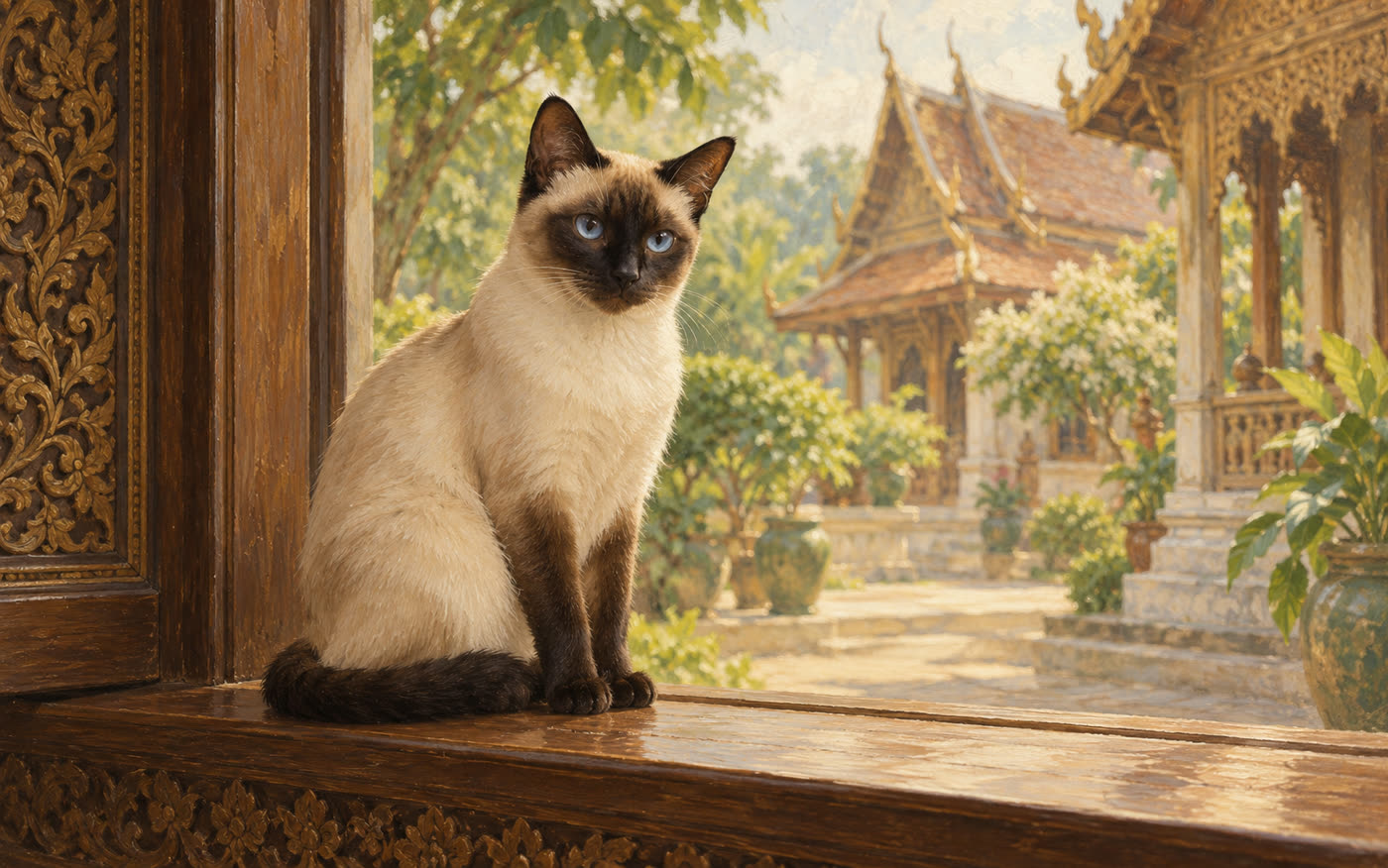
AI-generated illustration, not a historical image.
Explore canine court companions in royal dog breeds. For the Persian and Turkish Angora's journeys and preservation stories, visit historic cat breeds.
Prince Leopold's cat Snowdrop
The Royal Collection holds a July 1856 photograph by William Bambridge of Prince Leopold's cat Snowdrop, as described in HELLO!'s account of royal household cats.
Queen Victoria's White Heather
Queen Victoria had a cat named White Heather, reportedly a Persian, later inherited by Edward VII.
Read more about Persian cats and the Turkish Angora in our historic cat breeds guide.
Siam's court and the Tamra Maew
The Tamra Maew, or Cat-Book Poems, is attributed to the Ayutthaya period, 1351–1767. It places cats in Siam's literary past, but there is no evidence of an organized royal breeding program.
In 1884, British consul-general Edward Blencowe Gould brought a pair of Siamese cats, Pho and Mia, to Britain. Their kittens were shown at Crystal Palace in 1885.
Japan's imperial court
Emperor Uda's diary entry of March 11, 889 is the earliest record of a cat in Japanese sources.
In 1602, an order released cats to protect silkworms.
Ancient Egypt: a prince's cat sarcophagus
A cat sarcophagus dating to about 1350 BC is attributed to Prince Thutmose. Alongside cat mummies and the goddess Bastet, it gives cats a place in ancient Egyptian religious and royal history.
The British Museum received 192 cat mummies in 1907. For the later histories of the Egyptian Mau and Abyssinian, see historic cat breeds.
Korat: a Thai gift tradition
The Korat is Thailand's good-luck cat, traditionally given in pairs to newlyweds and respected people.
Myths and misconceptions
Only royalty could own Siamese cats
The ownership restriction is unsupported. There is also no evidence of an organized royal breeding program.
Queen Victoria founded Persian breeding
This claim is unsupported. Owning White Heather, reportedly a Persian, did not make Victoria the founder of Persian breeding.
Imperial orders created Japanese Bobtail tails
The 1602 order released cats to protect silkworms; it did not call for cutting their tails. The tail-cutting story is folklore.
Modern breeds prove direct descent from ancient Egyptian cats
The sarcophagus and mummies do not establish that family line. The Egyptian Mau's ancient link is not established by genetics, while genetic studies of the Abyssinian point to Southeast Asia and Europe.
FAQ
Did Queen Victoria have a cat?
Yes. Her cat White Heather was reportedly a Persian and was later inherited by Edward VII.
Who photographed Prince Leopold's cat?
William Bambridge photographed Snowdrop in July 1856. The Royal Collection holds the photograph.
What is the Tamra Maew?
It is the Cat-Book Poems manuscript, attributed to the Ayutthaya period, 1351–1767, and associated with Siamese cat history.
What did Japan's 1602 cat order do?
It released cats to protect silkworms.
Where can I read more about pets in history?
Our royal dog breeds guide introduces court favorites and dogs remembered by name. Our historic cat breeds guide follows feline journeys, cat shows, and preservation efforts.
Sources
- Wikipedia: Queen Victoria's pets
- HELLO!: Royal household cats and Snowdrop's Royal Collection photograph
- Wikipedia: Siamese cat
- Wikipedia: Korat
- CFA: Korat
- Wikipedia: Japanese Bobtail
- Wikipedia: Cats in ancient Egypt
- Wikipedia: Egyptian Mau
- Wikipedia: Abyssinian cat
Want to keep your own pet's portrait? See how to turn a favorite photo into a canvas.