Historic cat breeds: journeys, cat shows, and legends
A letter about long-haired cats, white Angoras preserved in Ankara, and a Maine Coon winning at Madison Square Garden each open a different chapter of cat history. Follow these breeds through travel, literature, exhibitions, and the people who helped bring them into American homes.
Swipe or scroll sideways to compare all columns.
| Breed | Earliest record mentioned in this guide | Kind of evidence | How solid |
|---|---|---|---|
| Siamese | Tamra Maew, Ayutthaya period (1351–1767) | Manuscript | Attribution to a period |
| Persian | 1620 letter / 1626 return | Letter and a disputed account | Disputed |
| Turkish Angora | Long-haired cats reached England and France in the late 16th century | Arrival account | Arrival history; no exact year given |
| Japanese Bobtail | Emperor Uda's diary, 889 | Diary | Solid for a domestic cat; breed identity not established |
| Egyptian Mau | Modern breeding began in 1953 | Breeding record | Modern; ancient genetic link not established |
| Abyssinian | Zula, 1868 | Named cat | Debated as the first Abyssinian |
| Chartreux | 1558 poem | Poem | Written mention; monk origin story disputed |
| Maine Coon | Cosey, 1895 | Show record | Solid |
| Russian Blue | First printed mention in Britain, 1862 | Print record | Printed mention; Arkhangelsk origin uncertain |
| Manx | Isle of Man mutation | Genetics | Solid on mechanism, legends aside |
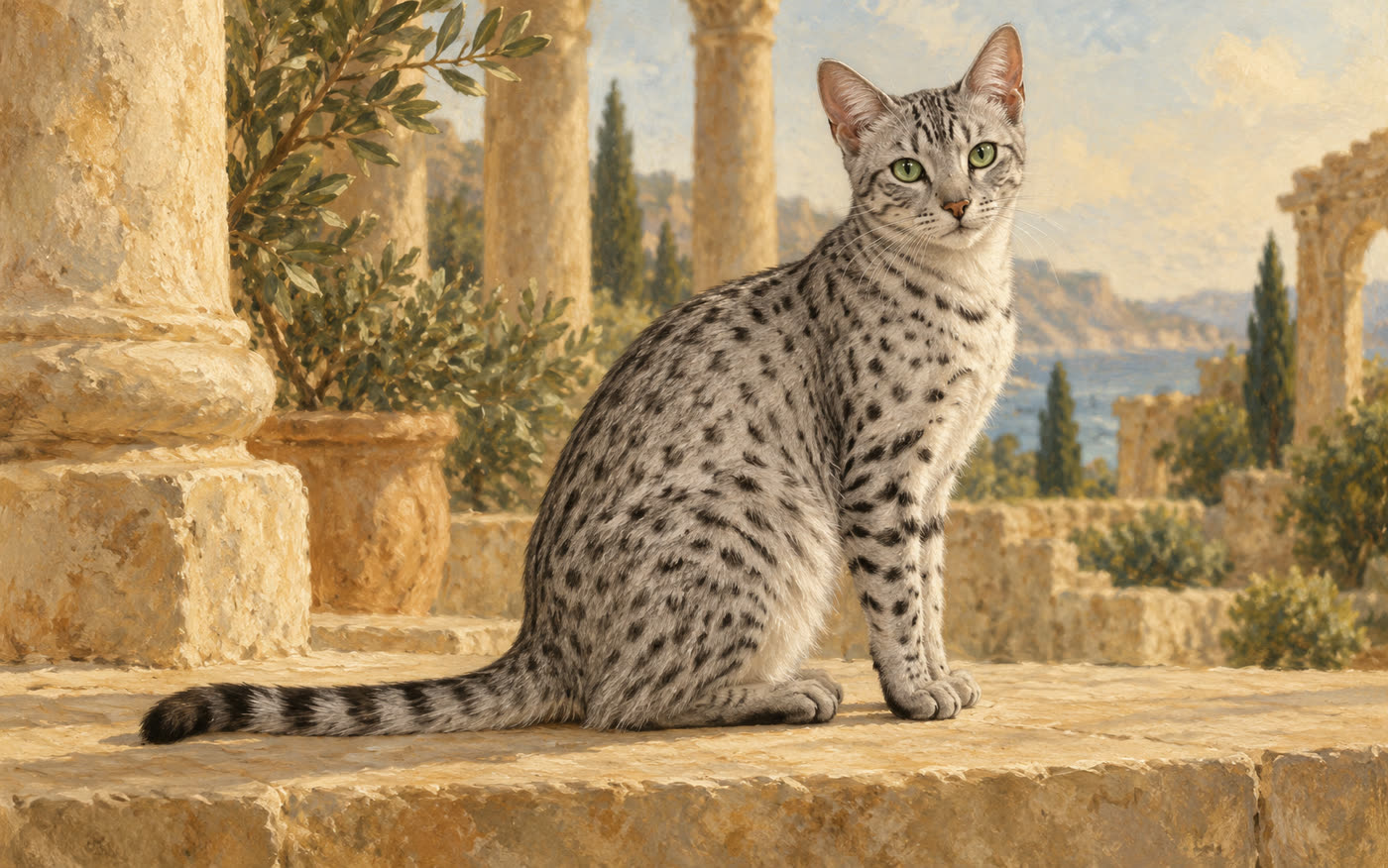
AI-generated illustration, not a historical image.
For individual palace pets, visit royal cats. Our royal dog breeds guide follows canine companions at courts and in aristocratic households.
Siamese
The Tamra Maew, or Cat-Book Poems, manuscript is attributed to the Ayutthaya period, 1351–1767. In 1884, British consul-general Edward Blencowe Gould brought Pho and Mia to Britain; their kittens were shown at Crystal Palace in 1885.
Today: The CFA describes a long, slender body with color at the points and a temperament that is vocal, affectionate, active.
Persian
The Cat Fanciers' Association, or CFA, says Pietro della Valle returned to Italy from Persia in 1626 with long-haired cats; other historians note that his 1620 letter only records his plan to bring them, and the cats are not mentioned again.
Persians appeared at the first Crystal Palace cat show in 1871 and were among CFA's founding breeds in 1906.
Today: The CFA describes a stocky body, long full coat, and round head with a short nose, calls the Persian sweet, affectionate, quiet, and says it needs a serious commitment to regular grooming.
Turkish Angora
The Turkish Angora is a natural breed of Anatolia. Long-haired cats reached England and France from the late sixteenth century.
In the twentieth century, Ankara's Atatürk Forest Farm and Zoo preserved white Angoras.
Today: The CFA describes a silky coat of intermediate length that is not prone to matting and a temperament that is busy, curious.
Japanese Bobtail
Emperor Uda's diary entry of March 11, 889 is the earliest definitive record of a domestic cat in Japan. In 1602, an order released cats to protect silkworms. The Japanese Bobtail attained CFA championship status in 1976.
Today: The CFA describes a short pom-pom tail and a temperament that is active, intelligent and affectionate.
Egyptian Mau
In 1953, Princess Natalie Troubetzkoy, living in Rome, obtained her first Mau — according to one account, with help from the Egyptian ambassador, who had the cat sent from Cairo. Her cats were shown in Rome in 1955. She emigrated to the United States in 1956 with three Maus.
According to CFA, the Egyptian Mau is the only naturally spotted domestic cat breed. For ancient cat sarcophagi and mummies, visit royal cats.
Today: The CFA describes a spotted pattern in silver, bronze and black smoke, calls the Egyptian Mau athletic and active, and says it sheds minimally.
Abyssinian
A cat named Zula was brought to Britain in 1868 by Sir Robert Napier's expedition. Whether she was the first Abyssinian is disputed.
Genetic studies point to Southeast Asia and Europe as the breed's background.
Today: The CFA describes a ticked coat, calls the Abyssinian busy, active, agenda-driven and affectionate, and says it needs very little grooming.
Chartreux
The Chartreux was first mentioned in Joachim du Bellay's poem in 1558. Charles de Gaulle later had a Chartreux named Gris-Gris.
Today: The CFA describes the Chartreux as blue only, well muscled, with a medium woolly coat and a temperament that is even-tempered and adaptable.
Maine Coon
On May 8, 1895, a Maine Coon named Cosey was named Best in Show at the first major North American cat show, at Madison Square Garden in New York.
The breed attained CFA championship status in 1976 and became Maine's official state cat in 1985.
Today: The CFA describes a large, rugged cat that is gentle, easy going yet active and recommends combing two or three times a week.
Russian Blue
The Russian Blue possibly originated in the port of Arkhangelsk, though its origin remains uncertain. Its first printed mention in Britain dates to 1862. It was shown at Crystal Palace in 1872 and given its own class in 1912.
Today: The CFA describes a short, dense silver-tipped blue coat and a temperament that is graceful, playful and quiet.
Manx
The Manx's taillessness comes from a spontaneous dominant mutation that spread through the founder effect on the Isle of Man. Noah's Ark, Spanish Armada, and cat-rabbit hybrid stories about its origins are legends.
Today: The CFA describes a quiet, gentle temperament, often attaching to one or two family members.
Myths and misconceptions
Egyptian Mau and Abyssinian cats prove ancient Egyptian descent
The Egyptian Mau's ancient link is not established by genetics. Genetic studies of the Abyssinian point to Southeast Asia and Europe. Neither a breed name nor resemblance to ancient cats proves a direct ancestral line.
Carthusian monks bred the Chartreux
The origin story is disputed. In 1972, the order said its archives contained no record of it.
Marie Antoinette's cats founded the Maine Coon
This is a legend, with no demonstrated ancestral link to the royal cats.
FAQ
Which historic cat breed is the oldest?
These histories do not give a reliable ranking. A first written mention, an arrival in another country, and breed recognition mark different events.
What is the early written reference to the Chartreux?
The breed appears in Joachim du Bellay's poem from 1558.
Who brought Egyptian Maus to the United States?
Princess Natalie Troubetzkoy emigrated in 1956 with three Maus, after obtaining her first Mau while living in Rome in 1953.
Which Maine Coon won at Madison Square Garden?
Cosey was named Best in Show on May 8, 1895, at the first major North American cat show in New York.
Where do royal pets fit into this history?
Meet named palace pets in royal cats, or explore royal dog breeds for canine court favorites.
Sources
- Wikipedia: Siamese cat
- CFA: Persian
- Wikipedia: Persian cat
- Wikipedia: Turkish Angora
- Wikipedia: Japanese Bobtail
- Wikipedia: Egyptian Mau
- CFA: Egyptian Mau
- Wikipedia: Abyssinian cat
- Wikipedia: Chartreux
- Wikipedia: Maine Coon
- CFA: Maine Coon
- CFA: Siamese
- CFA: Turkish Angora
- CFA: Japanese Bobtail
- CFA: Abyssinian
- CFA: Chartreux
- CFA: Russian Blue
- CFA: Manx
- Wikipedia: Russian Blue
- Wikipedia: Manx
- Wikipedia: Emperor Uda's diary