Famous cats in art: a closer look at feline subjects
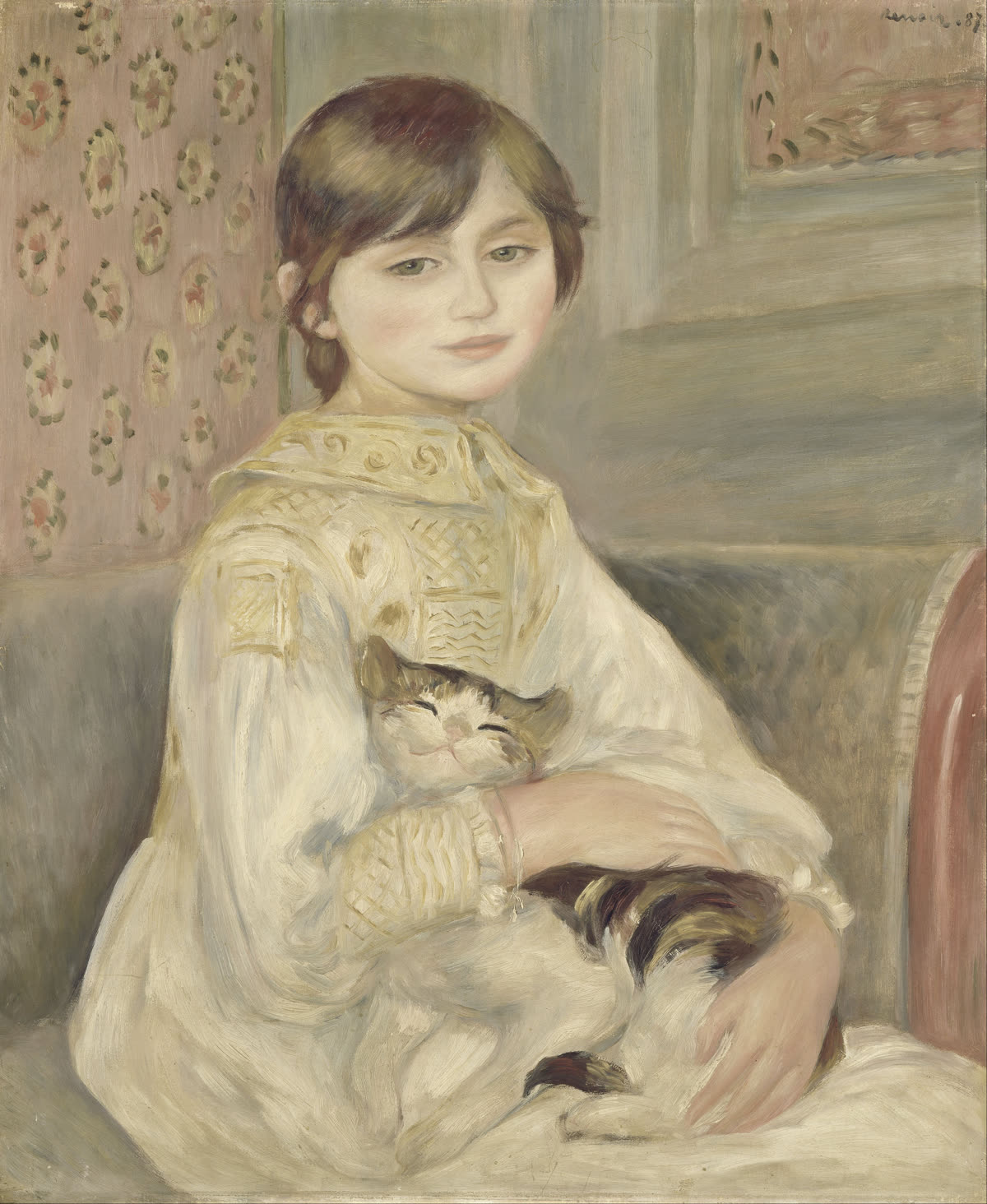
Goya's cats watch a bird, Renoir's cat rests in Julie Manet's arms, and Steinlen's black cat commands a poster. In paintings, drawings, and sculpture, feline subjects can bring tenderness, tension, humor, or a religious presence to a scene.
Look at the cats' eyes, paws, and posture: their attention often leads you through the scene. For the lives behind memorable feline names, visit famous cats in history. Our royal cats guide introduces pets from palace households.
Olympia — Édouard Manet
What you see — A black cat stands at the foot of the bed, its tail raised against the dark background. Manet painted Olympia in 1863; it was first shown at the Salon in 1865 and is in the Musée d'Orsay.
Why the cat matters — In a common reading, Manet replaced the little dog of Titian's Venus of Urbino, a symbol of fidelity, with a black cat, an animal associated with the night. The raised tail also makes this corner feel alert, though scholars differ over the cat's meaning.
Manuel Osorio Manrique de Zúñiga — Francisco Goya
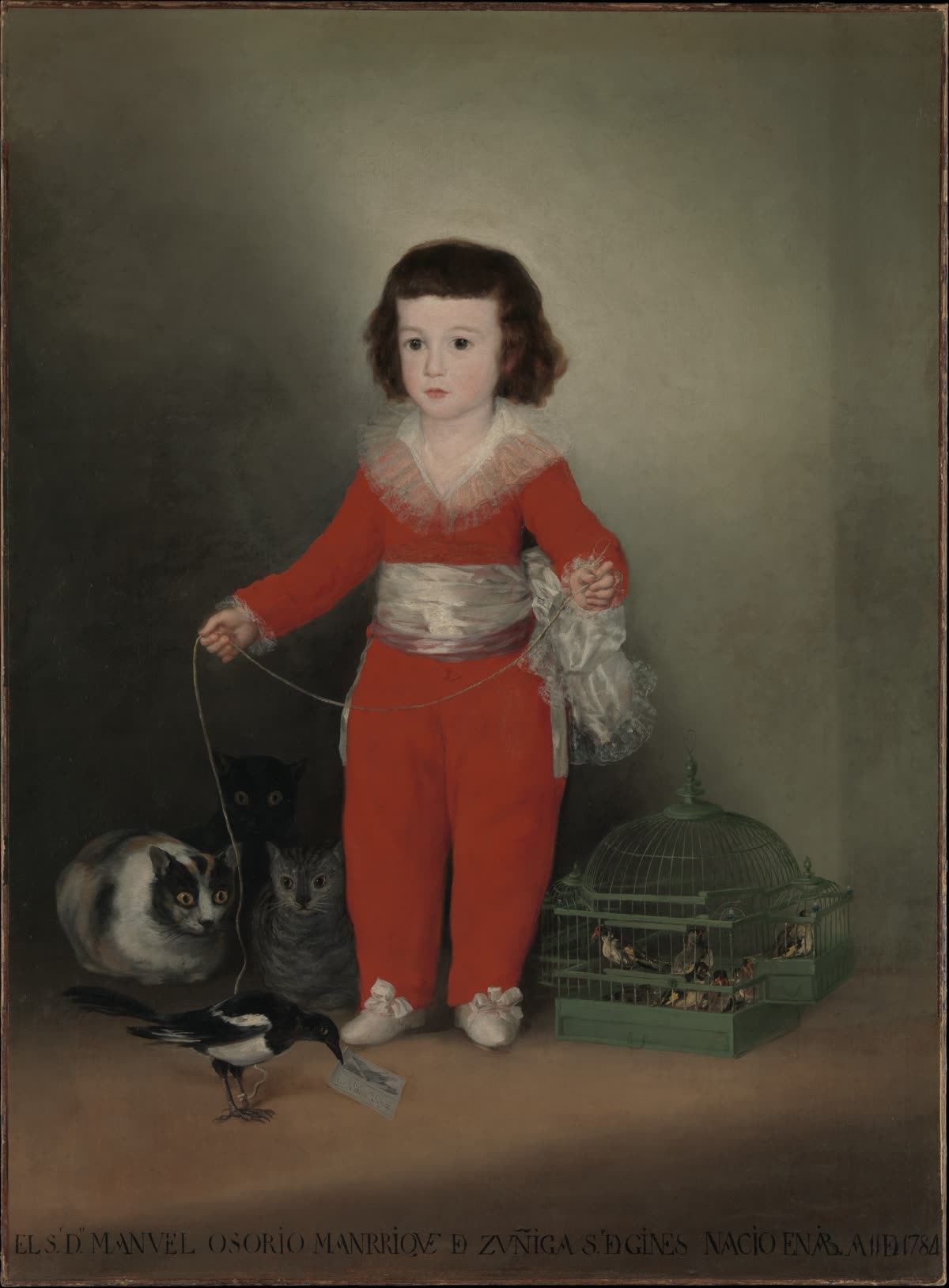
What you see — Manuel holds a string tied to his pet magpie, which carries Goya's visiting card in its beak. A cage of finches sits beside him while three cats stare at the bird. The portrait is usually dated 1787–88 and belongs to the Metropolitan Museum of Art, accession 49.7.41, in the Jules Bache Collection. Manuel was born in 1784 and died in 1792 at the age of eight.
Why the cat matters — The cats' fixed gaze makes the magpie look vulnerable. The caged birds are often read as innocence and the cats as a threat, though meanings are debated.
Julie Manet with Cat — Pierre-Auguste Renoir
What you see — Julie holds the cat close, her arms surrounding its body. Its eyes are almost closed, and fur and fabric meet around its face. Painted in 1887, the portrait shows Julie Manet, daughter of Berthe Morisot and Eugène Manet.
Why the cat matters — The cat's relaxed posture turns the portrait into a quiet cuddle. Its nearly closed eyes contrast with the watchful cats in Goya's painting.
Cat and Bird — Paul Klee
What you see — A cat's broad face fills the image, with a small bird above its eyes. Klee made Cat and Bird in 1928 using oil and ink on gessoed canvas mounted on wood. It is in the Museum of Modern Art, New York.
Why the cat matters — The bird's position can suggest a thought occupying the cat's attention. The large face and tiny bird make that fixation visible without a hunting scene.
Gayer-Anderson Cat — an ancient Egyptian bronze
What you see — The bronze Gayer-Anderson Cat represents the goddess Bastet and dates to the Late Period, approximately 664–332 BC. About 42 cm tall, it is in the British Museum. Its earrings and nose ring may not be original.
Why the cat matters — Here feline form represents a goddess. The bronze and jewelry give the animal a ceremonial presence, far removed from the soft fur and close embrace in Renoir's portrait.
Tournée du Chat Noir — Théophile Steinlen
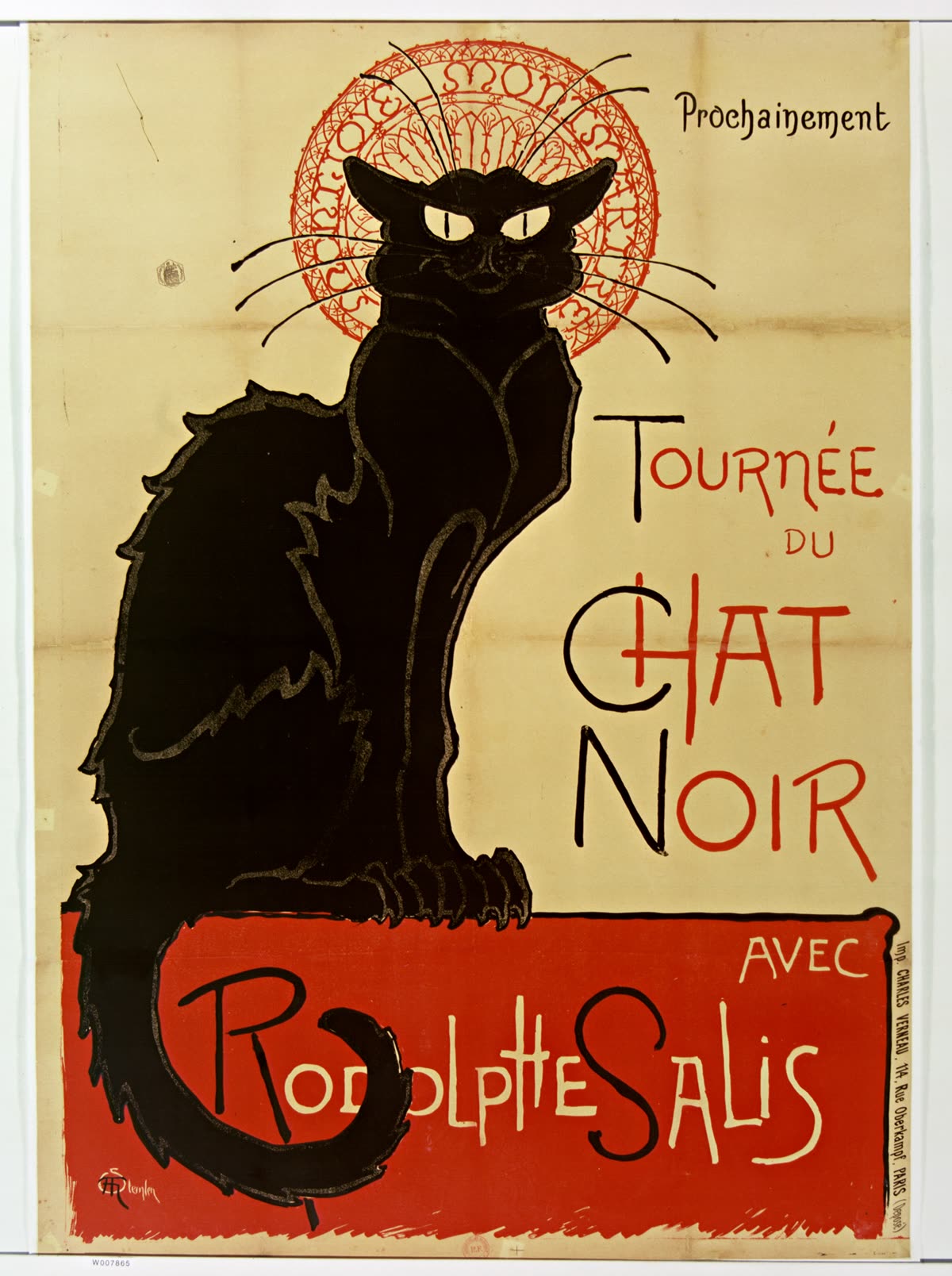

What you see — A black cat sits tall beside the lettering, with pale eyes, spreading whiskers, and a curling tail. Its dark outline stands out against yellow and red. Steinlen made the 1896 poster for the touring company of the Chat Noir cabaret in Montmartre.
Why the cat matters — The upright silhouette competes with the large lettering for attention. Ears, whiskers, and tail make the cat immediately recognizable even in the poster's flat shapes.
Louis Wain: cats with human lives
English artist Louis Wain (1860–1939) is best known for drawings of anthropomorphized cats. His feline subjects take on human roles, letting a cat's face and body carry the humor of the scene.
In 1924, his sisters had him certified and admitted to Springfield Mental Hospital. From 1930, he lived at Napsbury Hospital, where he died. Claims that his increasingly abstract cats show schizophrenia are speculation; he kept painting in his earlier style at the same time.
Six Studies of a Cat — Thomas Gainsborough
What you see — The drawing gathers views of a cat in stretched poses and curled resting shapes. Dating to about 1763–69, Six Studies of a Cat is featured in the Rijksmuseum's selection of cats in its collection.
Why the cat matters — Follow the curve of a back, then find the head and paws in each pose. The repeated views show how much a resting cat's outline changes as it shifts position.
The Dancing Lesson — Jan Steen
What you see — Children hold a cat upright as they teach it to dance. The Rijksmuseum's feature dates The Dancing Lesson to 1660–79 and identifies it as a work in the museum.
Why the cat matters — The children's handling may look uncomfortable to a cat owner. Compare the upright animal with Julie's quiet embrace in Renoir's portrait: one scene asks a cat to perform, while the other lets it rest.
Myths and misconceptions
Goya's cats have a proven meaning of evil
Their meaning is debated. A common reading sees the caged birds as innocence and the cats as a threat.
The black cat in Olympia has a single fixed meaning
A common interpretation contrasts Titian's dog, a symbol of fidelity, with Manet's black cat and its associations with the night. Scholars also offer other readings.
The bronze cat's jewelry must all be original
The Gayer-Anderson Cat's earrings and nose ring may not be original.
Louis Wain's paintings prove a diagnosis
Claims that the abstract cats show schizophrenia are speculation. Wain continued painting in his earlier style at the same time, so the pictures do not form a simple sequence of increasing abstraction.
FAQ
Where is the cat in Olympia?
Look at the foot of the bed, beside the woman's feet. Its black body and raised tail meet the dark background.
What are Goya's cats watching?
The three cats stare at Manuel's pet magpie, held on a string. The bird carries Goya's visiting card in its beak; a cage of finches sits nearby.
Who is holding the cat in Renoir's portrait?
Julie Manet, daughter of Berthe Morisot and Eugène Manet, holds the cat in the portrait painted in 1887.
Is the Chat Noir image a painting?
It is Steinlen's 1896 poster for the touring company of the Chat Noir cabaret in Montmartre.
What is Louis Wain known for?
Drawings of anthropomorphized cats: feline subjects given human roles.
Are all these cats portraits of pets?
No. The Gayer-Anderson Cat represents Bastet, and other works place cats in different settings. For another feline timeline, explore historic cat breeds.
Sources
- Wikipedia: Olympia
- Metropolitan Museum of Art: Manuel Osorio Manrique de Zúñiga
- Wikipedia: Manuel Osorio Manrique de Zúñiga
- Wikipedia: Julie Manet
- Wikipedia: Cat and Bird
- Wikipedia: Gayer-Anderson Cat
- Wikipedia: Tournée du Chat Noir
- Rijksmuseum: Cats in the collection
- Wikimedia Commons: Cat and Bird image
- Wikimedia Commons: Six Studies of a Cat image
- Wikimedia Commons: The Dancing Lesson image
- Wikipedia: Louis Wain


Your own cat has a story worth keeping. Explore ways to preserve a favorite pet photo.